







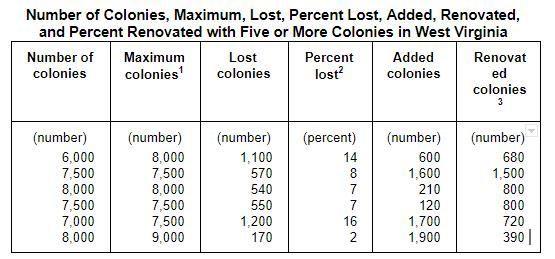
Charleston, West Virginia — Honey bee colonies for operations with five or more colonies in West Virginia as of Jan. 1, 2021, totaled 7,000, up 17% from Jan. 1, 2020. The number of colonies in the state on April 1, 2021, was 8,000. During 2020, honey bee colonies on Jan. 1, April 1, July 1, and Oct. 1 were 6,000, 7,500,8,000 and 7,500, respectively.
Honey bee colonies lost for operations with five or more colonies from January-March 2021, were 1,200 colonies, or 16%. The number of colonies lost during the quarter of April-June 2021 was 170 colonies or 2%. During the quarter of January-March 2020, colonies lost totaled 1,100, or 14%, the highest of any quarter surveyed in 2020. The quarter surveyed in 2020 with the lowest number of colonies lost was July-Sept., with 540 colonies lost, or 7%.
Honey bee colonies added for operations with five or more colonies from January-March 2021 were 1,700 colonies. The number of colonies added during the quarter of April-June 2021 was 1,900 colonies. During the quarter of April-June 2020, 1,600 colonies were added, the highest number of honey bee colonies added for any quarter surveyed in 2020. The quarter of October-Dec. 2020 added 120 colonies, the lowest number of honey bee colonies added for any quarter surveyed in 2020.
Honey bee colonies renovated for operations with five or more colonies from January-March 2021 were 720, or10%. The number of colonies renovated during the quarter of April-June 2021 was 390 colonies or 4%. The quarter surveyed in 2020 with the highest number of colonies renovated was April-June with 1,500 colonies renovated, or 20%. The quarter surveyed in 2020 with the lowest number of colonies renovated was January- March, with 680 colonies renovated, or 9%. Renovated colonies are those that were requeened or received new honey bees through nuc or package.
Varroa mites were the number one stressor for operations with five or more colonies during all quarters surveyed in 2020. The quarter of April-June 2020 had the highest percentage of colonies reported to be affected by varroa mites at 46.2%. The percent of colonies reported to be affected by varroa mites during January-March 2021 and April-June 2021 was 13.7% and 5.2%, respectively.
United States — Honey bee colonies for operations with five or more colonies in the United States on January 1, 2021, totaled 2.92 million colonies, up 2% from January 1, 2020. The number of colonies in the United States on April 1, 2021, was 2.86 million colonies. During 2020, honey bee colonies on Jan. 1, April 1, July 1, and Oct. 1 were 2.88 million, 2.97 million, 3.18 million, and 3.14 million colonies, respectively.
Honey bee colonies lost for operations with five or more colonies from January through March 2021, was 372,630 colonies, or 13%. The number of colonies lost during the quarter of April through June 2021 was 255,860 colonies, or 9%. During the quarter of October through Dec. 2020, colonies lost totaled 484,920colonies, or 15%, the highest number lost of any quarter surveyed in 2020. The quarter surveyed in 2020 with the lowest number of colonies lost was April through June, with 300,990 colonies lost, or 10%.
Honey bee colonies added for operations with five or more colonies from January through March 2021 were 308,530 colonies. The number of colonies added during the quarter of April through June 2021 was 677,690. During the quarter of April through June 2020, the number of colonies added were 536,170 colonies, the highest number of honey bee colonies added for any quarter surveyed in 2020. The quarter of October through December 2020 added 271,500 colonies, the least number of honey bee colonies added for any quarter surveyed in 2020.
Honey bee colonies renovated for operations with five or more colonies from January through March 2021 was 156,270 colonies or 5%. During the quarter of April through June 2021, the number of colonies renovated were 480,380 colonies or 17%. The quarter surveyed in 2020 with the highest number of colonies renovated was April through June with 626,870 colonies renovated, or 21%. The quarter surveyed in 2020 with the lowest number of colonies renovated was October through December 2020, with 128,990, or 4%. Renovated colonies are those that were requeened or received new honey bees through a nuc or package.
Varroa mites were the number one stressor for operations with five or more colonies during all quarters surveyed in 2020. The period with the highest%age of colonies reported to be affected by varroa mites was July through September 2020 at 55.7%. The percent of colonies reported to be affected by varroa mites during January through March 2021 and April through June 2021 are 31.3% and 48.7%, respectively.
Honey bee colonies lost with Colony Collapse Disorder symptoms on operations with five or more colonies was 76,930 colonies from January through March 2021. This represents a 27% decrease from the same quarter in 2020.